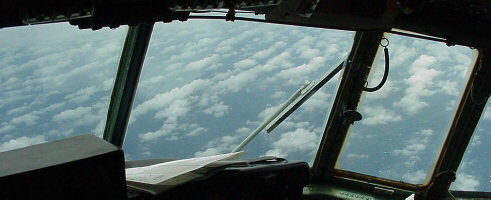
| The WC-130 casts a shadow as it takes
off on its mission to Carlotta.
| 
|
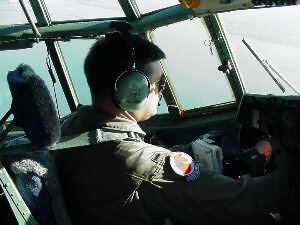
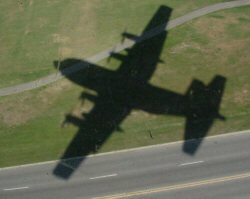
| The coast of Mississippi is
visible from Pilot Rob's window as the plane heads out across the Gulf of
Mexico towards it's prey.
|
| The bright orange bands on radar show where the heaviest rain
is falling, around the eye of Carlotta. The eye itself is a dark,
nearly rectangular shape near the center of this picture. It appears
to be open to the southwest (lower left) corner of the storm, which
may also be due to heavy rain ("attenuation") blocking a view of the far side of
the eye as we approach from the northeast.
Although most are round, it is not unusual
to see the eye go through a variety of shapes and sizes through its
lifespan.
| 
|
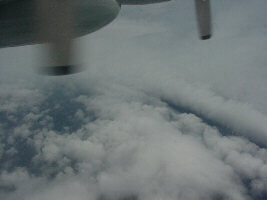
| The inside of the eye is rather dark, surrounded by the heavy
rain clouds of the eyewall. We catch glimpses of the sea
below, through breaks in the lower clouds. We're flying at 10,000
feet right through the middle of the storm.
|
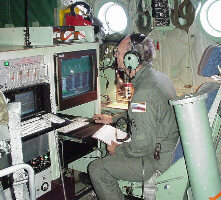
| Dropsonde Operator Burt works at his computer station. After
releasing an instrument into the eye (and eyewall) of the storm, he carefully
checked the accuracy of the temperature, pressure, humidity, and wind
data which the falling sonde radioed back to the plane. This information
then went instantly to the National Hurricane Center in Miami by a
satellite link, along with a flood of data from sensors mounted on
our airplane.
| 
|
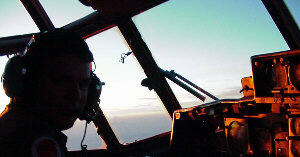
| The crew sent data from the eye during three passes
through the storm, then headed back home. It was a long, 12-hour
flight, with a golden sunset on the return leg.
|